Showing posts with label PTC7. Show all posts

Tuesday, September 12, 2017

My latest EdTalks: Developing cultural responsiveness in schools

Developing cultural responsiveness at Cobham Intermediate from EDtalks on Vimeo.


Last year when I was the Deputy Principal at Cobham Intermediate, I was asked to be filmed for an EdTalks special on cultural responsive practice and what this can look like in action in a school setting and how we were going about developing a culturally responsive environment. 

I focused my discussion on the way this happens from a relational position and how the staff at Cobham Intermediate began this journey together working on their practice, and then spread that learning to their classrooms. I tried to outline how important it has been for staff to consider the tikanga in the school and that the values they are developing around this practice will be beneficial for all, while reminding us all that the kaupapa of a school is developed as part of a school’s obligations under the Treaty of Waitangi and being part of a bicultural nation, and that this is an important position for all schools.


Thursday, July 20, 2017

Digital apps to support teaching and learning


Even though I have moved back into school life and am no longer a digital technologies advisor, I still have the absolute pleasure of being asked to co-facilitate the Ako Panuku 'Technology for teachers' hui each year with my good friend and co-facilitator Dee Reid.

Naturally at these types of hui, we get asked about what the 'best' apps/websites are for the classroom.  And Dee and I always respond with the same answer - the technology is just a waka/vehicle or tool, you need to firstly understand what you trying to achieve, what is the learning task?

Ako Panuku created this very cool resource for teachers showcasing some possible apps that can be used as the waka/vehicle for different learning tasks e.g. researching, summarising, presenting etc.  This was created in Thinglink - a powerful tool in itself!

https://www.thinglink.com/scene/806367909889703936%20

If you hover over the app, a description will pop up.  You can also hover over the different strategies and get a pop up description and if you click on the down arrow you can even download a word doc copy of the description and step by step how it can be used, including a link to a template.

Ngā mihi nui ki a Ako Panuku!!!

And if those apps don't satisfy your thirst for new and engaging ways to integrate tech tools into your classroom, then I am sure these will...


Tuesday, February 23, 2016

So what is an ILE - innovative learning environment?


The huge changes taking place in education throughout New Zealand are not just isolated to our country.  This shift or move to what the Ministry of Education initially called MLE's or modern learning environments but has now more accurately been coined ILE or innovative learning environment, has been rippling throughout schools around the world.  With all this change, comes a lot of confusion.  Many parents and even teachers are grappling with the new jargon/terms and even the purpose for the change to teaching practice and a new way of learning for our tamariki.

This video is a fantastic resource by some of our leading educators worldwide, that supports and explains what an innovative learning environment is, what changes you can expect and most importantly - why.

Take a moment to watch this and consider what they are saying.  I found what they were describing to be hugely inspiring and motivating and as a mother, this is exactly what I wish for my child's education.

It gives me great hope and excitement about our journey to create an innovative learning environment at our kura and about the kind of amazing tamariki that innovative learning systems will no doubt produce!

Friday, February 12, 2016

Whanaungatanga in action!


A new year has arrived.  The summer holidays flew by as they always do for us teachers and before we know it we are back at work.  This time last year was my first day at a new job, at a new school and I remember clearly how awkward the first teacher only day was for us newbies.  The school did things quite differently to what I was used to and because of this and it's sheer size and therefore number of staff and students, it took me quite a long time to settle in and feel like I belonged.  This is not an easy thing to navigate, especially being Māori and coming from a previous job where tikanga Māori took pride of place.  Not having mihimihi meant I did not know who everyone was, where they came from and if we were perhaps connected somehow.  Not having karakia tīmatanga, waiata or karakia whakamutunga before and after hui was also jarring as it felt like we went in cold and separated to hui instead of combined as one and when we finished everyone just went their separate ways.  This is not a criticism of my school, merely pointing out that at this time, these elements of tikanga Māori were not in place, which no doubt was one of the reasons I was hired, and if you have read my earlier posts you will know that many of these things are now highly valued and implemented daily at our school.  But in response to that feeling of isolation from the start of last year, I planned a very different teacher only day this year.

Firstly, I changed the name from teacher only days to staff retreat and the emphasis for our retreat would be whanaungatanga and effective planning for 2016.  I asked the Principal and BoT to support this initiative with some funding, which they kindly did and I promptly went about booking accommodation and a conference venue in Hanmer Springs for 2 days in Jan. An agenda was created early in Term 4 where all staff could add their ideas to and volunteer to take certain sessions or workshops over the 2 days.  Some of the things we worked through was all the day to day running of the school issues like duty, curriculum update and responsibilities, sport/music/cultural responsibilities, planning and appraisal etc.  But excitingly, we also covered some awesome new ideas like collaboratively creating a M.A.T.E's  document (mutually agreed team expectations) for the way we as staff will work together and practiced a process for mihi whakatau for when we welcome manuhiri, in line with Ngāi Tūāhuriri tikanga as mana whenua. We also spent time talking about PB4L (positive behaviour for learning), Teaching as Inquiry and all of our LwDT (learning with digital technologies) initiatives planned for this year.  I might be showing how much of a geek I am but it was awesome stuff! Highly engaging, productive, collaborative and relevant for all staff.

One of the best outcomes for our staff retreat though was the obvious effect it had on building a sense of whānau for us all.  Staff were sharing rooms together, car pooling up to and back from Hanmer, having a drink together, going for walks together, having dinner together, working in groups throughout the 2 day hui and all the time, building a strong sense of whanaungatanga.  We got to know the person behind the teacher - what they liked or disliked eating, how tired they were because of waking babies at home,  that they snore loudly or that they can play the guitar.  We even started our first day playing a game called "Whanaungatanga".

One person stands and starts talking about themselves - where they are from, family members, interests...anything they want.  When someone else can connect to what they are saying, for example if I said I have 3 children and someone sitting down also has 3 children, they stand and yell out "whanaungatanga"!  Then they take over and start talking about themselves until the next person can buzz in with a 'whanaungatanga".  This game was great to hear more about each other, to demonstrate that although we might all lead different lives, we all can connect to each other in some way too and it also was awesome to hear the improved te reo Māori pronunciation!  And do you know what really blew my mind and made my heart sing...when I walked around our school on the first day back for our kids, several of the classes I walked into were playing "whanaungatanga" - ka mau te wehi!

Tuesday, July 7, 2015

Flippin' awesome teaching for a new generation


Yesterday I attended the Burnside Learning Community Cluster un-conference. Held on the first day of the holidays, many teachers and support staff came together from almost all of the early childhood, primary and secondary schools in our cluster to network, share ideas and to learn.

The keynote by Dr Cheryl Doig from Think Beyond was called 'Into the Future' and raised some excellent points about the changes education is facing. I went on to several different breakouts afterwards but one particularly grabbed my attention. I went to see a secondary science teacher, @mattynicoll and his breakout called 'Rewind Learning' (see the video above of another time he has shared this presentation online).

I have been interested in flipped learning for a few years now but I was excited to see and hear examples in my own backyard. I first heard about a teacher at Breens Intermediate doing some cool things, just starting off by recording himself & posting it to his YouTube channel https://www.youtube.com/user/mrmteacherbreens.

This is exactly how Matt described his beginning too and that he just had to push past the fear of looking/sounding silly and embrace the possibilities that posting learning activities online would offer his students. Allowing kids to watch the video at their own pace, watch it after school hours, rewind and watch over and over, watch it before or after the actual physical lesson at school and to share it with others who might also have an interest in it and could work together with you on the concept is just a few of the awesome benefits to recording and sharing lesson content online. Matt's YouTube channel is also an awesome resource https://www.youtube.com/user/mattynicoll and its very cool to see just how well the lesson have developed and grown in quality and confidence!

The concept of flipping the classroom sounds time consuming and challenging at its most complex but what I got from listening to Matt share his experiences, is that you can take it at your own pace, to a level that you are comfortable with. All you have to do is give it a go, try something new, be innovative, take risks, step outside your comfort zone...you know, all the stuff we ask our students to do!

But don't take my word for it, I am by no means an expert. If it's an experts opinion you are after though, perhaps take a listen to this guy, one of my all time favs!


Michael Fullan: Technology, the new pedagogy and flipped teaching


Friday, February 13, 2015

Passionate prototyping!


Life is busy in a school.  Anyone Everyone in education will be aware of that but slipping back into the fast current of a large busy school is a constant reminder to me that there is no job in education where you are not constantly busy.  It often gets hard to focus on the big picture when we get bogged down in the small details, so often.

We started our first teacher only day this year with our principal @scottthelning sharing the video clip above.  It was a good reminder about the creative journey we at Cobham Intermediate are on in preparation for a complete school re-build in 2016.  Some key phrases immediately jump to the forefront when watching it...designing something requires focus, how do we want people to feel, it takes time, enhances each life it touches.  These are some key drivers that should remain in mind when working through the design process and more importantly, the impact it's all having on our students.

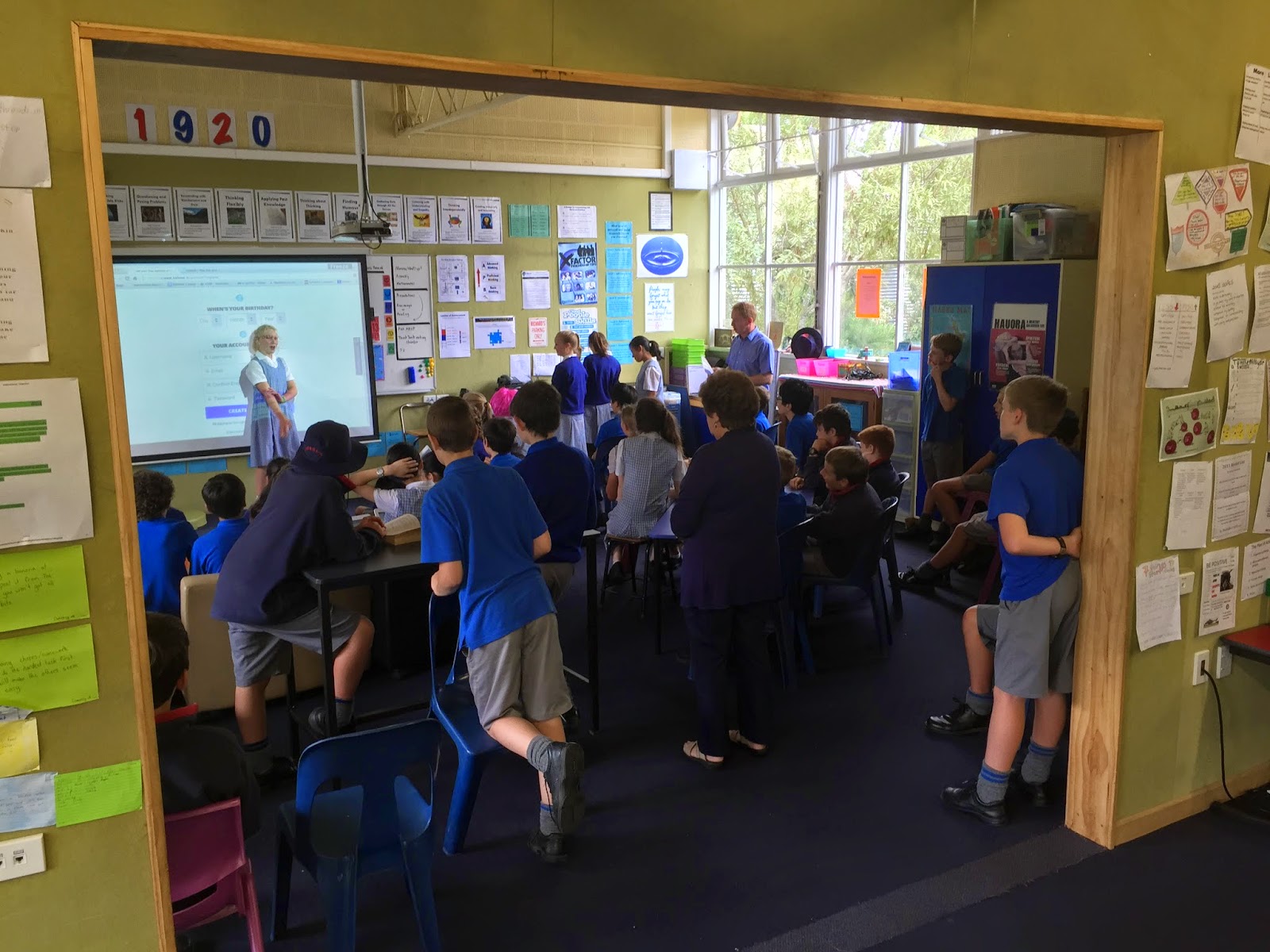
Last year Cobham trialled a collaborative space by knocking out walls, opening/joining up the spaces between 2 old classrooms. This was the first stage of MLE (modern learning environment) prototyping.   The 2 teachers in each of the 2 spaces had the opportunity to re-design their space, creating flexible learning areas to better meet the needs of the students.  Students had input into this process by identifying what furniture they might need and why, where it should go and how the classes could work together and eventually become one.  The teachers went through the same processes in regards to their collegial relationship as well.  It was so successful that all 4 teachers insist that they could no longer go back to teaching independently in a single cell classroom.  They felt the kids were getting a 2 for 1 deal by having access and support to 2 teachers at all times, built close friendships with more students and learned to work and collaborate with all types.  The kids reiterated the same feelings.


So guess what, now we have 4 classroom blocks with holes in the walls.  There has been no compulsory stand on this, no demand from leadership as to everyone must work in a collaborative space and by when.  This has come from teachers identifying that they want to try it, in fact there was even an application process for the teachers as not all classrooms could be converted and there were more who wanted the opportunity to work collaboratively in an open space rather than those who didn't.  These teachers want to take risks, do things differently, have some exciting new learning taking place and to have some epic fails.  Which was awesome because they learned so much from these epic fails and shared this with their colleagues who are dipping their toes into the prototyping pool this year.


I can't wait to see who might put up their hand in the next school holiday block and ask for a chainsaw and some of our amazing builder Dad's to come in and attack their classroom next, if possible!

And to all those out there in the busy education world who are also in the prototyping phase-congratulations on taking the first step! Keep your focus, hang in there it takes time, remember you are trying to enhance each life your teaching touches!